
Searching Ashland County Criminal Dockets
Pick your court first. Felonies sit in the General Division of the Ashland County Court of Common Pleas. Its Case Search is the official public entrance. The portal runs on a JavaScript session, so expect that stage before any search fields appear. If a Common Pleas record eludes you, write or visit the Clerk Legal Division at 142 W. Second St., Ashland, Ohio 44805. You can also call 419-282-4242.
Misdemeanors, ordinances, parking tickets, and adult traffic cases run through Ashland Municipal Court. Its GovRec portal has a Criminal Search that works without an account. When that stalls, the Criminal/Traffic Clerk at 419-289-8137 is the fallback. One caution applies. A docket lookup is an information request, not a filing. The Municipal Court rejects documents sent by email or fax.
- Decide whether the matter is a felony, a Municipal Court criminal or traffic matter, or a juvenile matter.
- Use the appropriate official entry point. Open the Common Pleas Case Search for a General Division matter, or select Criminal Search in GovRec for Municipal Court.
- For GovRec, choose the available search mode and enter only the requested information. Name search requires first and last name; a date of birth may be added.
- Open a matching result only to review the case basics and Details workflow. The research did not verify a full public document inventory or result-column layout.
- When accuracy matters, ask the court or clerk for the current docket or a copy instead of relying on a portal display alone.
Ashland County Criminal Docket Courts
The court name tells you most of what you need in an Ashland County criminal docket search. Ohio sends felony trials to the Common Pleas General Division. Ashland Municipal Court covers the whole county for misdemeanors, city ordinances, traffic, and parking. It also handles early or pre-indictment felony steps. That early role does not make it the felony trial court. Juvenile delinquency and juvenile traffic belong to the Juvenile Division. That division posts no general public juvenile-traffic search.
| Court or division | Criminal docket role | Starting route |
|---|---|---|
| Common Pleas General Division | Felony criminal cases and their General Division proceedings. | Common Pleas links to Case Search, Court Calendar, and eServices. |
| Ashland Municipal Court | Countywide misdemeanor, ordinance, traffic, parking, and preliminary felony matters. | GovRec Criminal Search or the Criminal/Traffic Clerk. |
| Common Pleas Juvenile Division | Juvenile traffic and delinquency matters, subject to restricted access. | Juvenile Division rather than the adult Municipal portal. |
Choosing the wrong court is the most common dead end. Despite its name, Ashland Municipal Court is not city-only. Its criminal docket reaches every corner of Ashland County.
Inside an Ashland County Criminal Docket
Think of an Ashland County criminal docket as a running court record. It is not a story. It names the matter, lists dated entries, and shows upcoming hearings or case status. An entry title is not automatically a ruling, though. A docket cannot replace a transcript either. Common Pleas case numbers run with a year prefix and a letter for the case type. A sequence then follows, and it resets each year. Ashland Municipal Court lets you search by case number, but it publishes no case-number format.
| Case number | An identifier for the matter. A Common Pleas number uses a year prefix, an alphabetical case type, and a sequence that resets annually; no universal shorthand legend was published. |
|---|---|
| Docket entry | A dated filing, order, notation, or recorded action. It is not necessarily a final ruling. |
| Court date | A scheduled appearance or hearing. Municipal GovRec provides Court Date as a search mode. |
| Plea | The response to a criminal charge. GovRec does not provide an online not-guilty action. |
| Disposition | The recorded result or action at the end of an issue or case; verify the controlling entry with the court when needed. |
Take 2026 CR 00001. It shows the Common Pleas pattern only. This is not a real case or a live sample.
Ashland County GovRec Criminal Search
The Municipal Court links its public criminal search to GovRec. It is shifting to a new case-management system at the same time. The Criminal Search screen lays out the search choices before any individual record opens. That field list helps. Still, treat the portal as an index rather than a full file archive. Court instructions say basic results lead to Details and sometimes to eligible payment. They never promise that every document is public online.
| GovRec criminal field | When used | Observed format or limit |
|---|---|---|
| Search By | Selects Name, Citation (Ticket), Case Number, Court Date, or Filed Date. | Required fields change with the mode. |
| Name | Finds by first and last name. | Both names are marked required; date of birth is optional and uses an MM-DD-YYYY placeholder. |
| Citation or case number | Finds the stated ticket or case. | Each is required in its mode; no local number-format legend was published. |
| Court Date or Filed Date | Searches a date range. | Both start and end dates are required. |
| Display Closed Cases | Broadens a search. | Optional checkbox, not a promise of universal historical coverage. |
The court-linked GovRec Criminal Search is shown in the official source image below.
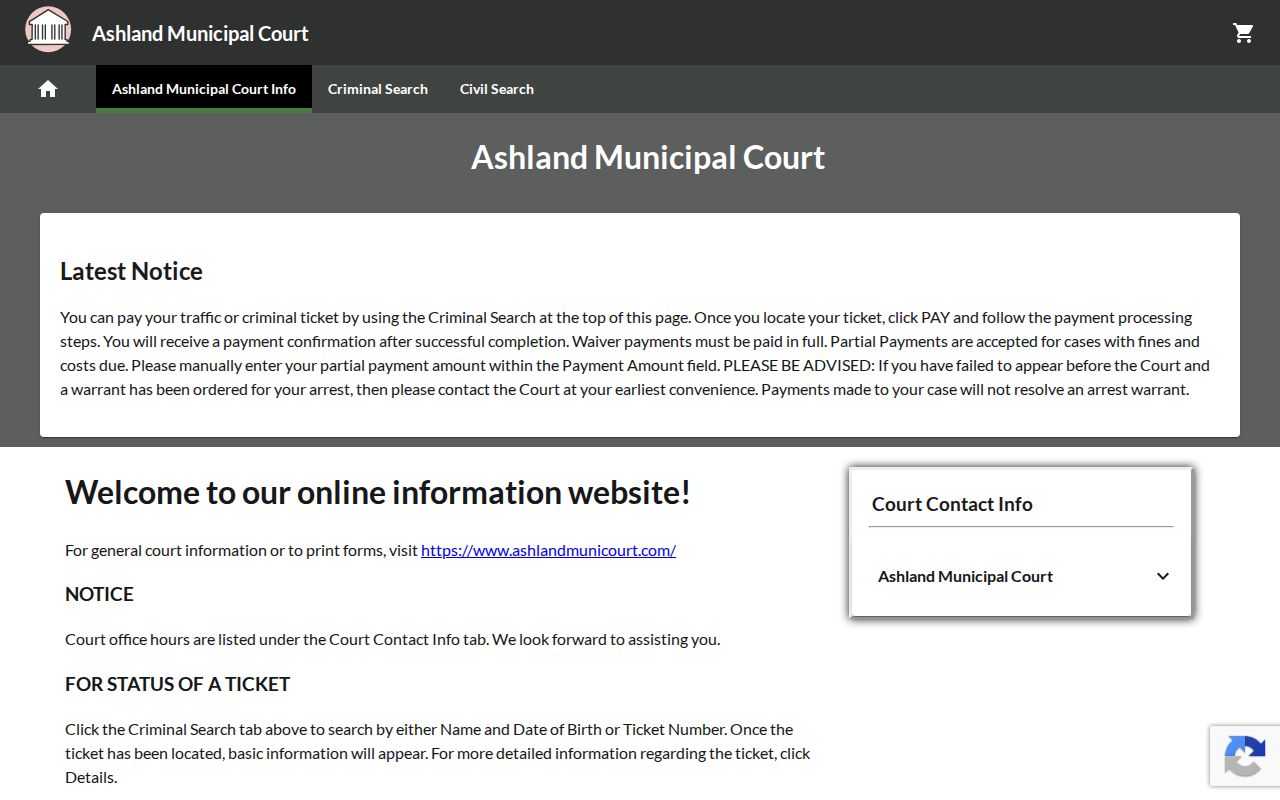
The page documents the public search entry point itself. It is not a personal docket or a person-name search result.
How a Criminal Case Moves
At Common Pleas, the local rules sketch the path. After the initial bond, an arraignment or appearance follows when feasible. Motion, intervention, and other hearings come as needed. From there, a case may head to a plea change or a jury trial. Sentencing usually lands about four to six weeks after a plea or trial. That timing holds when a presentence investigation is required and not waived. The framework describes procedure, not a promised date for any one case.
Docket flow: Filing or charge → arraignment → pretrial or motion setting → plea or trial → disposition → sentencing.
Municipal Court runs its own criminal calendar. Regular arraignments fall on Tuesday and Friday at 9:00 a.m., adjusted around holidays. If a criminal pretrial requires you, follow the court notice. An unjustified absence can affect speedy-trial time under the local rule.
Ashland County Criminal Arraignment Terms
A handful of short terms make an Ashland County criminal docket much easier to read. Each one marks a step in the case. None of them decides guilt on its own. The definitions here stick to court process rather than guesswork about a record.
- Arraignment
- An early hearing at which the charge is stated and a plea is taken.
- Indictment
- A formal felony charge returned by a grand jury and filed in Common Pleas.
- Pretrial
- A scheduled case-management stage before trial. Municipal rules generally require a defendant to attend a criminal pretrial.
- Continuance
- A court-approved postponement, not merely a changed personal plan.
- Warrant
- A judicial directive that is not cleared simply by making an online payment, according to the Municipal portal information.
These terms only hint at what a docket may signal. For the fuller record behind a filing, ask the clerk, the court reporter, or the court itself.
Courts That Hold Criminal Dockets
Ashland County keeps no single database for its criminal dockets. Felony cases sit with Common Pleas. Local criminal and traffic cases sit with Municipal Court. The Juvenile Division stands apart as well. Ohio offers no unified statewide public trial-court docket search either, so you cannot skip the step of picking the right Ashland County court before you search.
One tool needs special care. Common Pleas eServices is a registered system for filing and retrieving documents, not a public search form. Under the local rules, registered users file, review, and retrieve documents, subject to clerk acceptance. A self-represented filer can register and e-file through paper or a public-access terminal at first, but that filing process is not a criminal docket lookup.
Once you locate the case, calendars live elsewhere. The Ashland County court dates route splits the Common Pleas calendar from the Municipal Court Court Date search.
Ashland County Criminal Docket Delays
Treat an online result as a lead. It is not the verified court record. The Ashland County Clerk of Courts warns that online filing and action data can lag at least 24 hours. Sometimes the delay runs longer. When a recent hearing, filing, or entry matters most, that delay bites hardest. Ask the court or Clerk for confirmation rather than trusting a slow display.
The Municipal Court adds its own wrinkle. It reports an active case-management-system transition. Questions about the new system go to its Clerk. The Municipal Court forms page also states that email and fax submissions meant for filing are rejected. Calling a clerk to check access is one thing. Filing by email is simply not allowed.
That official forms page sets out the Municipal Court filing restriction shown next.
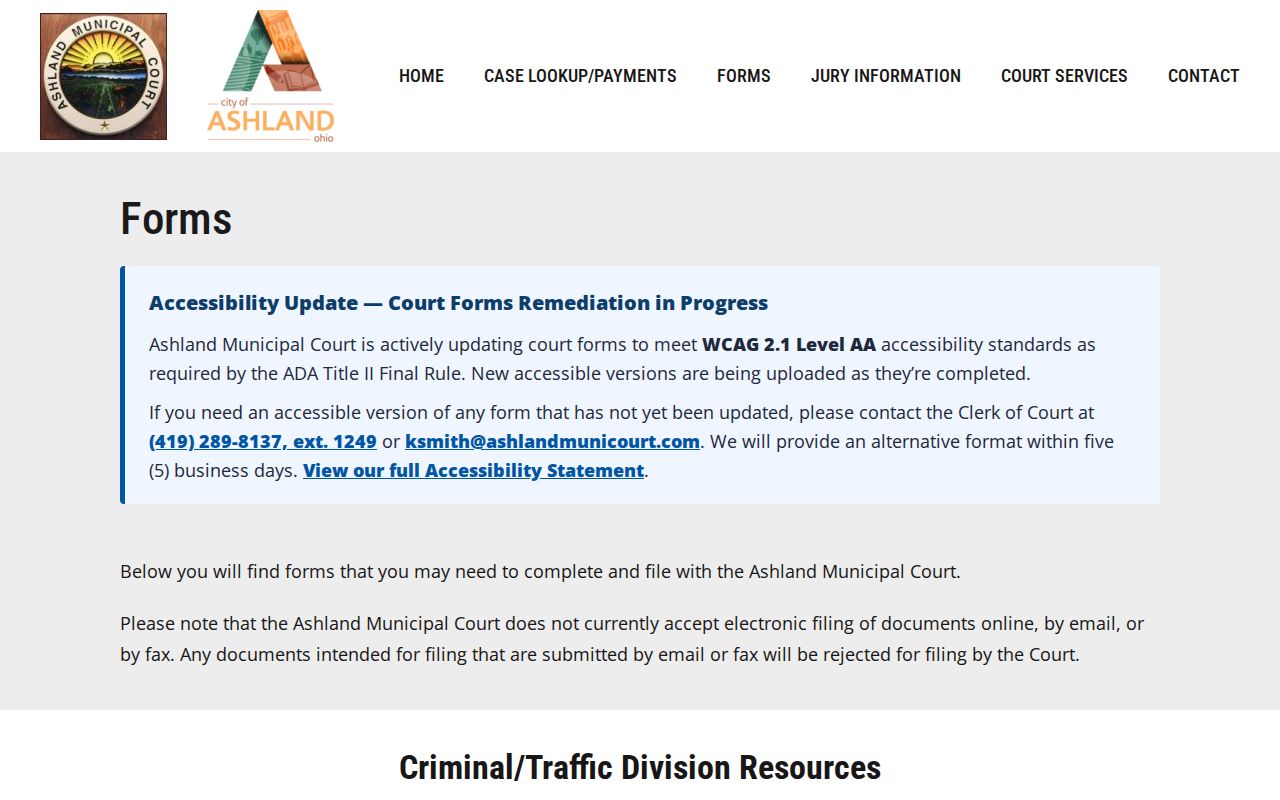
The rule keeps two things distinct: checking an Ashland County criminal docket and making a valid court filing.
Sealed Dockets and Public Access
Rule 45 presumes Ohio court records are open. Yet the rule framework, statutes, and court orders all impose real limits. Access in person can be broader than remote access. So a missing online entry never proves a record does not exist. A delay could explain it. So could a search mismatch, a restricted document, an older record, a system setting, or a sealing order. Under the Municipal local rules, sealed or expunged records are deleted from case search and public-access search once the order is entered. The hard-copy record is sealed and indexed.
Ohio access rules.
Ohio Rule of Superintendence 45 presumes public access while addressing restrictions, redaction, direct access, and remote access.
R.C. 2303.12 requires the Clerk to keep a general docket and addresses electronic access to clerk-kept documents.
R.C. 2953.32 sets the adult sealing and expungement procedure and its record effects, subject to eligibility and exclusions.
Juvenile records are generally closed to the public under the local Probate/Juvenile policy. A portal result also cannot tell you whether someone has a criminal history or not. For a specific Ashland County criminal docket request, name the court and the case number if you have it, then ask the records custodian whether the material is public and which copy route applies.
Ashland County Criminal Docket Confirmation
A criminal docket search cannot always answer a time-sensitive question. Confirm the court, division, and case identifier first. Common Pleas questions go to the Clerk Legal Division or the court. For Municipal criminal and traffic matters, try the Criminal/Traffic Clerk. A restricted juvenile matter belongs with the Juvenile Division, not the adult portal. Each path honors the separate Ashland County record custodians.
Ask with precision. A docket, a single entry, a certified copy, and a transcript may each trigger different office procedures and costs. Transcripts depend on court reporter or electronic-record arrangements. A docket entry alone is never a transcript. Phrases like "current docket," "dated entry," or "certified copy" help the custodian pinpoint the request.
Note: Confirm a recent hearing or filing with the originating Ashland County court. The Clerk warns that online data may post later than the court action.