
Getting Ashland County Court Records
Figure out which court handled the matter before anything else. Common Pleas General and Domestic Relations legal records live with the Ashland County Clerk of Courts Legal Division. Probate and Juvenile routes record requests to its own Public Records Clerk. Ashland Municipal Court keeps its own clerk channels. Its criminal, traffic, civil, and small-claims files stay there. Go division by division. That keeps a judicial record from being treated as a generic county request.
- Identify the court division and case number, if known.
- Use the division’s official lookup to locate a public case or hearing detail.
- State the document, order, or docket entry sought and whether a plain or certified copy is needed.
- Ask the custodian about access limits, copy cost, delivery, and any advance deposit.
- Confirm a recently filed action with the clerk rather than relying only on an online display.
Each division runs its own entrance. Common Pleas offers official Case Search and Court Calendar screens. They depend on a JavaScript session layer, though. Probate CaseLook opens with an agreement screen. It states coverage from 1996 forward. Municipal GovRec serves as a case-lookup tool with an eligible-payment route. It is not a universal document repository or filing channel.
Ashland County Court Record Custodians
Who holds the file drives both access and cost. For Common Pleas records, the legal division's clerk is the official route. Probate and Juvenile apply a separate public-record policy. Municipal Court offers direct clerk contacts for criminal and traffic, and for civil. Name the record you want. Do not assume a different county office can pull it.
Clerk Legal Division
Ashland County Clerk of Courts
142 W. Second St.
Ashland, OH 44805
419-282-4242
Monday through Friday, 8:00 a.m. to noon and 1:00 p.m. to 4:00 p.m.
The Clerk of Courts names Deborah A. Myers as the elected clerk. It also lists legal and title division contacts. Common Pleas court records go through the Legal Division, not title services. For Probate and Juvenile, call the Public Records Clerk at 419-282-4216. Municipal Criminal and Traffic answers at 419-289-8137. Municipal Civil uses 419-281-4890.
Court Record Types
A court docket is the running list of actions in a case. The case file itself can hold pleadings, orders, returns of service, motions, judgments, and other court documents. Restrictions still apply. A certified copy is something else. It is a copy authenticated by the office that keeps the record. It differs from a search result and can carry a different fee. An official electronic document counts as the court's record even when no paper original exists.
| Record sought | First route | Boundary |
|---|---|---|
| Common Pleas docket or legal copy | Clerk Legal Division | Online data may lag; sealed material and some transcripts have limits. |
| Probate or Juvenile file | Probate/Juvenile Public Records Clerk | Policy, coverage, and juvenile limits differ by division. |
| Municipal traffic, criminal, civil, or small claims | Municipal Clerk or GovRec | GovRec lookup is not a filing or certified-copy service. |
| Federal docket | PACER or Northern District Clerk | It is not part of an Ashland County portal. |
Some questions sit near a court case but outside the Common Pleas legal clerk's files. Police reports, BMV history, property deeds, and marriage licenses each have their own holder. Ask the right office for those.
Ashland County Official Electronic Records
Under Common Pleas Local Rule 1.05, an e-filed or scanned electronic version is the official record. Rule 6.02 lets official case files be kept solely in electronic form. So a request for the "paper original" can miss what the court actually maintains. Ask for the official court record, or a copy of the document you have identified. Local Rule 6.04 governs copying: the clerk may make paper or electronic copies, subject to sealed-document and transcript limits and any advance deposit. Cameras and similar devices may not be used to copy a paper case file. The clerk also need not print a document that is generally printable online. The Clerk's record disclaimer warns that online entries can lag. That is one more reason a verified copy should come from the clerk.
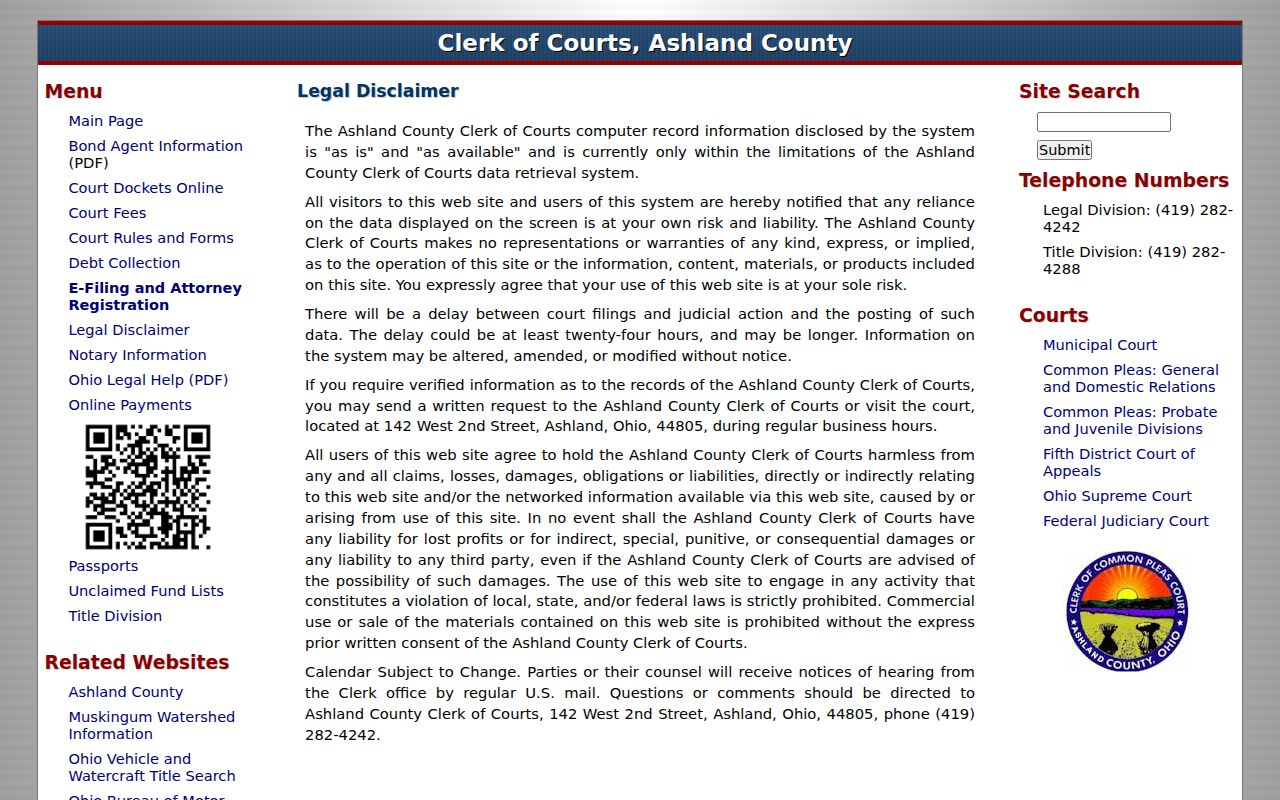
The takeaway is simple. Electronic data helps you locate a file; the clerk confirms the official record or copy.
Inside an Ashland County Court Record
What a public copy contains depends on the file and the access rules. A docket entry may show that an order was entered or a hearing was scheduled. Yet not every filed document is viewable remotely. Court records also shield personal identifiers and restricted material. Requesting a specific item with a case number beats asking for "everything" in a matter.
| Case number | The division’s identifier, used to locate the file and distinguish similar matters. |
|---|---|
| Caption | The title of the case, usually naming the sides or prosecuting authority. |
| Docket entry | A recorded filing, order, setting, or court action in chronological context. |
| Document requested | The identified order, motion, judgment, or other filed item, if public and available. |
| Copy type | Plain, certified, electronic, or another method the custodian confirms. |
| Restriction status | Whether rules, an order, redaction, or confidentiality limits inspection or copying. |
When possible, supply the case number, division, document title, and approximate date. The clerk can then explain whether the item is public, restricted, archived, or carries a copy charge.
Ashland County Probate Record Boundaries
Probate CaseLook states online coverage from 1996 forward, under its agreement, exclusions, and delay warning. Anything older belongs with the Probate and Juvenile Public Records Clerk. Probate records are generally public. Court policy, though, treats civil commitments, adoption reports, and abortion-bypass matters as nonpublic. Juvenile access takes a separate request. Juvenile traffic, delinquency, unruly, probation, abuse, neglect, and dependency matters are not public. That is the general rule under court policy. Some parentage, support-modification, and visitation matters are generally public. A missing Juvenile search result says nothing about the record's status.
Fees and Certified Copies
Copy charges are not countywide. The current Common Pleas Legal Division schedule took effect May 21, 2026. Probate and Juvenile publishes its own public-record schedule. Municipal Court publishes no ordinary or certified copy schedule, so ask that clerk directly instead of applying another division's rate.
| Custodian or item | Published fee | Notes |
|---|---|---|
| Common Pleas plain copy | $0.25 per page | Legal Division schedule. |
| Common Pleas certified copy | $1.00 per page | Certification by the Legal Division. |
| Common Pleas fax copy | $2 transmission plus $1 per page | Published clerk rate. |
| Probate/Juvenile plain copy | $0.10 per page | Possible advance payment and actual postage may apply. |
| Probate/Juvenile certified copy | $1.00 per page | Division-specific policy. |
| Municipal copies | Ask the Municipal Clerk | No general rate was found in reviewed official material. |
The Clerk's fee schedule covers filing and service fees. Those figures are not a promise of what a public-record request will cost.
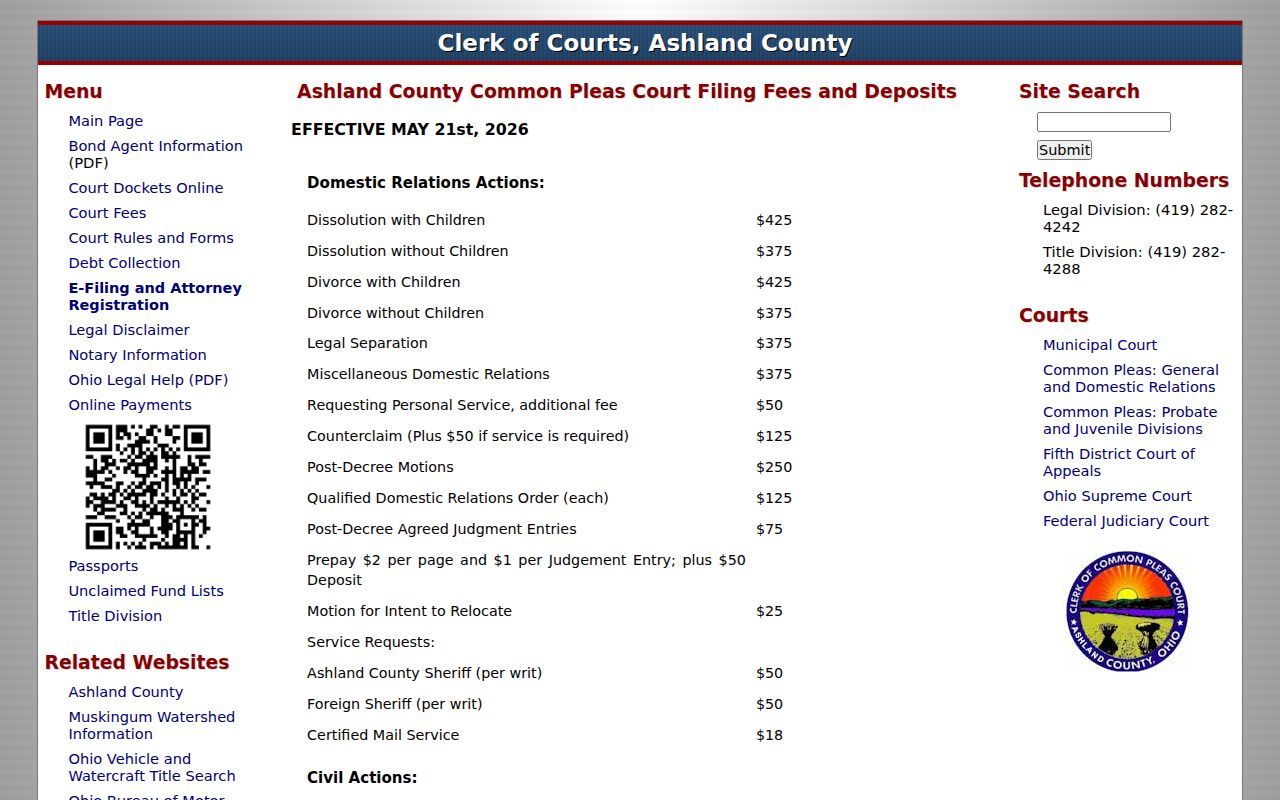
The Common Pleas clerk sets its own copy fees. Probate, Juvenile, and Municipal record requests each go through a separate office, so check with that office before paying anything.
Ashland County Court Records Compared
A court docket is not a countywide catchall. A BMV driver history, for instance, sits with the Ohio BMV, not the court. The court file covers only the citation or case record the court itself holds. Police investigative material belongs to the law-enforcement agency that gathered it. Deeds go to the County Recorder. Federal civil and criminal dockets live in the federal system. A court file may point to one of those records without holding it. The right move is to contact the agency that keeps the record. Do not ask a clerk to rebuild or transfer it. That focus keeps a request aimed at what the clerk can pull. The clerk can actually pull it from the Ashland County court records.
Sealed Records and Public Access
Ohio Rules of Superintendence Rules 44 through 47 frame public access to court records. Rule 45 matters most here. Ohio's Public Records Act sets a general baseline. But court-case access rests mainly on court rules and statutes. Viewing a docket from home is not direct access. It is not the same as access at the clerk's office.
Key Ohio rules: Rule 45 and related Rules of Superintendence cover court-record access, restrictions, and redaction. R.C. 149.43 is Ohio’s general public-record baseline. R.C. 2953.32 addresses adult sealing and expungement procedure and effect, subject to eligibility and exclusions.
A court can seal a case, an attachment, or an identifier even when the docket around it stays public. Ask whether a specific record is public and how access is allowed. No answer here promises a document image or a certified copy on the spot.
Ashland County Court Record Requests
For Common Pleas, give the case number if you have it. Also give the division, the document or order, the copy type, and how you want it delivered. Probate and Juvenile accept oral or written requests through the Public Records Clerk. The policy says you need not state your identity or purpose. A precise request still helps the clerk find the record and estimate any charge. The Probate and Juvenile policy promises records promptly and within a reasonable period when practicable. Volume, storage, review, and redaction can all slow things down. When an immediate answer is not possible, the court says it will acknowledge the request. It will also give a reasonable estimate. That is a records-access practice, not a pledge that every item can be released or copied right away. Common Pleas requests can go through the Legal Division counter. A written request or the official online route also works as the record allows. Probate and Juvenile lists acjuvenileprobate.records@zoominternet.net, plus mail or a visit at 142 W. Second St. For Municipal Court records, the division-specific clerk phone lines are the documented route. Municipal Court posts no dedicated public-record request form. Start with the clerk. Its forms page warns that documents emailed or faxed for filing are rejected. So do not treat email as an electronic court filing. And a records request never guarantees the court will file it or change a hearing setting.